Making Room for One Quiet Corner
A quiet corner is not a project, a renovation or a room. It is a chair, a lamp and a surface big enough for a cup, arranged deliberately, in a place that is not the desk and not the sofa in front of the television. Assembling one takes an afternoon at most and usually less.
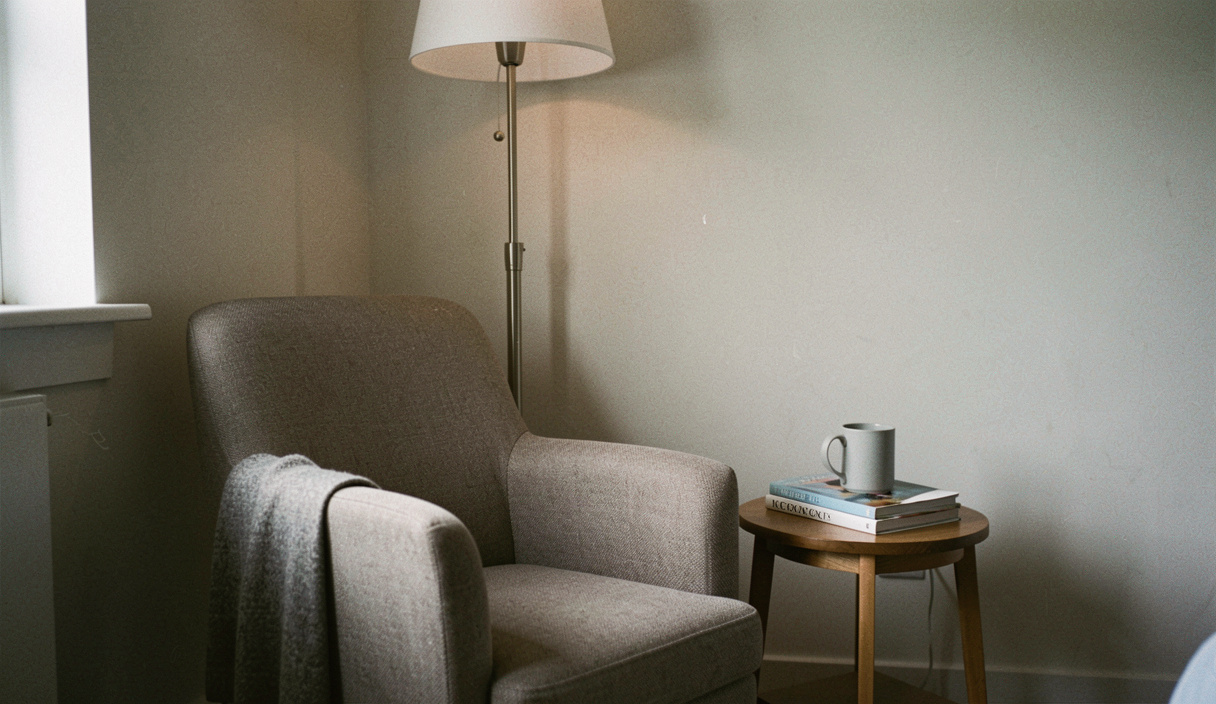
One corner, not one room
The reason to think in corners rather than rooms is availability. Very few households have a spare room, and the ones that do usually have it full of things. Almost every household has a corner, and a corner is enough, because what is being made is a place with a purpose rather than a space with a door.
The purpose matters more than the furniture. The corner exists so that resting has somewhere to happen. Without one, resting happens on the sofa in front of a screen, or at the desk, or in bed, and all three of those places already have a meaning attached to them.
This is the physical counterpart to the boundary described in the entry on drawing a line at a certain hour. A defended evening still has to be spent somewhere, and if the only available seat faces a television, that is where it will be spent.
What it needs
| Element | Why | Substitute |
|---|---|---|
| A chair you can sit in for an hour | Comfort decides whether it gets used | Any chair with a cushion behind the back |
| A light of its own | So the corner works when the room is dim | A clip lamp on a shelf |
| A surface within arm's reach | For a cup, a book, glasses | A stool, a stack of books, a windowsill |
| Something to read, already there | Removes the trip to fetch it | Anything, provided it lives in the corner |
The lamp is the element people skip and the one that decides whether the corner is used after dark, which is when it is most needed. A corner lit only by a ceiling fitting is not a separate place, it is part of the room.
Where to put it is a question the light answers. The exercise of walking through a flat and noticing where the afternoon light lands, described in the entry on daylight at home, usually identifies the corner before any furniture is moved.
A corner lit only by the ceiling light is not a separate place. It is just part of the room.
What it must not contain
Three things, and the list is short on purpose.
No work. Not a laptop, not a folder, not the bag. The moment the corner becomes a second desk it stops being anywhere, and the boundary it was built to hold disappears with it.
No charger. A phone charging in the corner means the phone lives there, and a phone that lives in a chair is what the chair is for. The charger belongs in a hallway, for the reasons described in the entry on screens before bed.
No storage. A quiet corner accumulates things faster than any other surface in a house, because it is the nearest flat space to wherever people put things down. Keeping it clear is a twenty minute job every few weeks, of exactly the kind set out in the piece on tidying one surface at a time.
Small flats and shared rooms
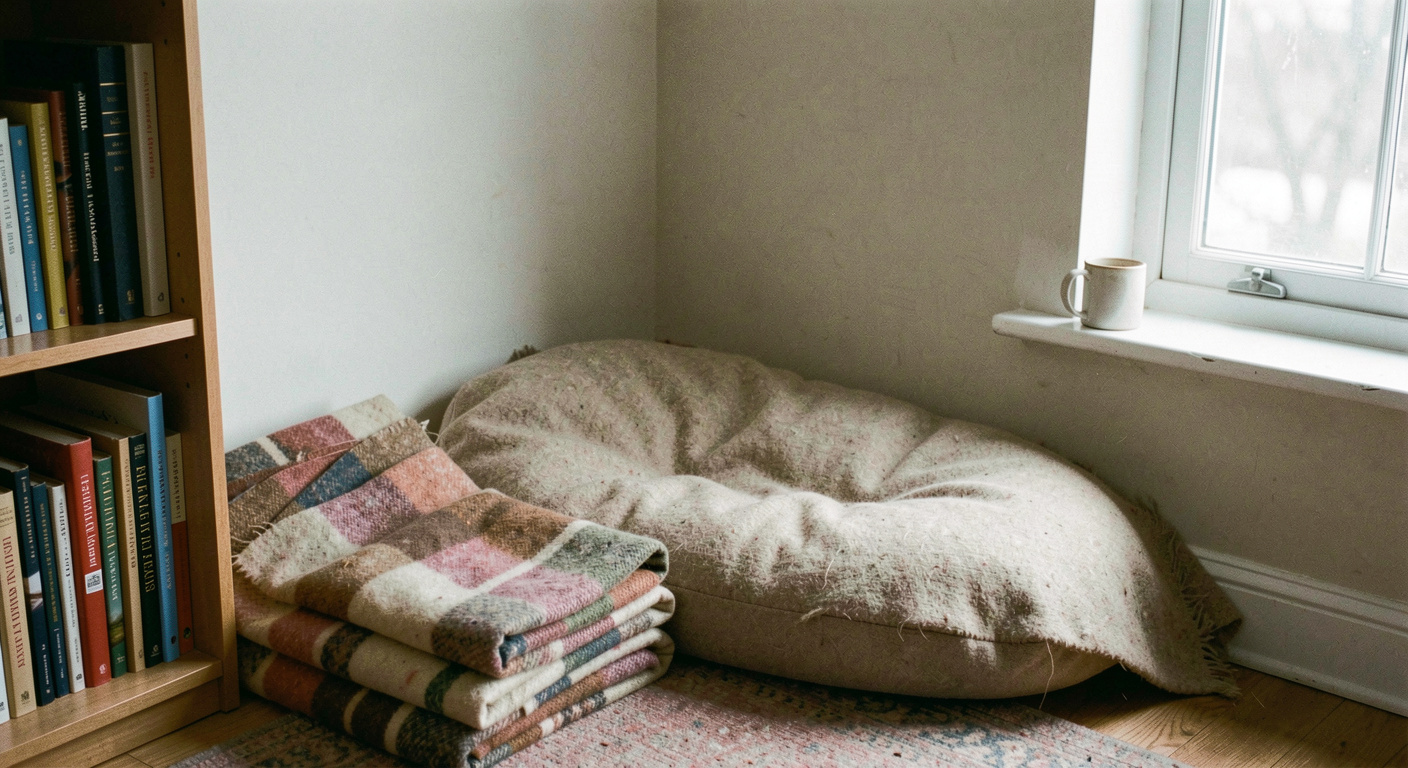
In a one room flat the corner has to be made out of orientation rather than space. A chair turned to face a window rather than the room, a cushion in the corner furthest from the door, a stool by a window with a shelf beside it. What makes it a corner is that it faces away from the working part of the room.
In a shared household the difficulty is not space but time, and the answer is usually an hour rather than a place: the corner belongs to whoever is in it, and the household agrees, more or less, not to start conversations there. That is a social arrangement and it works better if it is said out loud once rather than implied for six months.
For anyone whose corner is mostly used at the end of a day, it fits naturally into the sequence described in the piece on the four steps of an evening: the corner is where the third step, the one about slowing down, actually happens.
What we noticed
The corner we assembled took about forty minutes, most of it spent moving a laundry rack somewhere else. It consisted of a chair that was already in the flat, a floor lamp bought some years ago for a different room, a stool as a side table and a small stack of books.
It was used most in the evening and, unexpectedly, at around seven in the morning by whichever of us was up first. The morning use was not planned and is the part we would mention to anyone building one: a corner with good light in it acquires a morning function on its own.
What broke it, twice, was a laptop. Both times the corner stopped being used within about two days and both times it came back as soon as the laptop went back to the desk. That is a very small experiment and it is the clearest single result in this entry, which is why the rule about work is stated as flatly as it is above. The notebook, on the other hand, belongs there, and the habit that goes with it is in the piece on three sentences in a notebook.
Read next
Where to put the corner is a question about light, answered in the entry on natural light at home.
The corner is where a protected evening gets spent, which is the argument of the boundaries entry.
It is also where the third step of the evening sequence happens: see the entry on the routine that closes a day.
The one thing worth keeping in the corner besides a book is a notebook, for the habit described in our entry on a five minute notebook habit.