A Short Stretch Routine for Desk Days
Most stretch routines written for desk workers assume a floor, a mat, a change of clothes and ten minutes. None of those exist between a meeting that overran and one that is already starting. What exists is ninety seconds, standing up, in the clothes you are already wearing.

The ninety second window
The gap between two meetings is the most reliable slot in an office day. It happens several times, it requires no negotiation, and it is otherwise spent looking at a phone. It is also short, which is an advantage: a routine designed for ninety seconds cannot be postponed on the grounds that there is not enough time.
The design constraints are strict and worth stating. Nothing on the floor. Nothing that requires taking off a jacket. Nothing that looks strange enough to stop doing when a colleague walks past. Nothing that needs to be remembered in a particular order.
Four that fit anywhere
Four movements covered the areas that a seated day tends to affect, and all four pass the constraints above.
| Movement | Where | Roughly |
|---|---|---|
| Forearm on a doorframe, step gently forward | Any doorway | Twenty seconds each side |
| Ear towards one shoulder, other hand relaxed | Standing or seated | Fifteen seconds each side |
| Hands behind the back, chest opened, shoulders down | Standing, anywhere | Fifteen seconds |
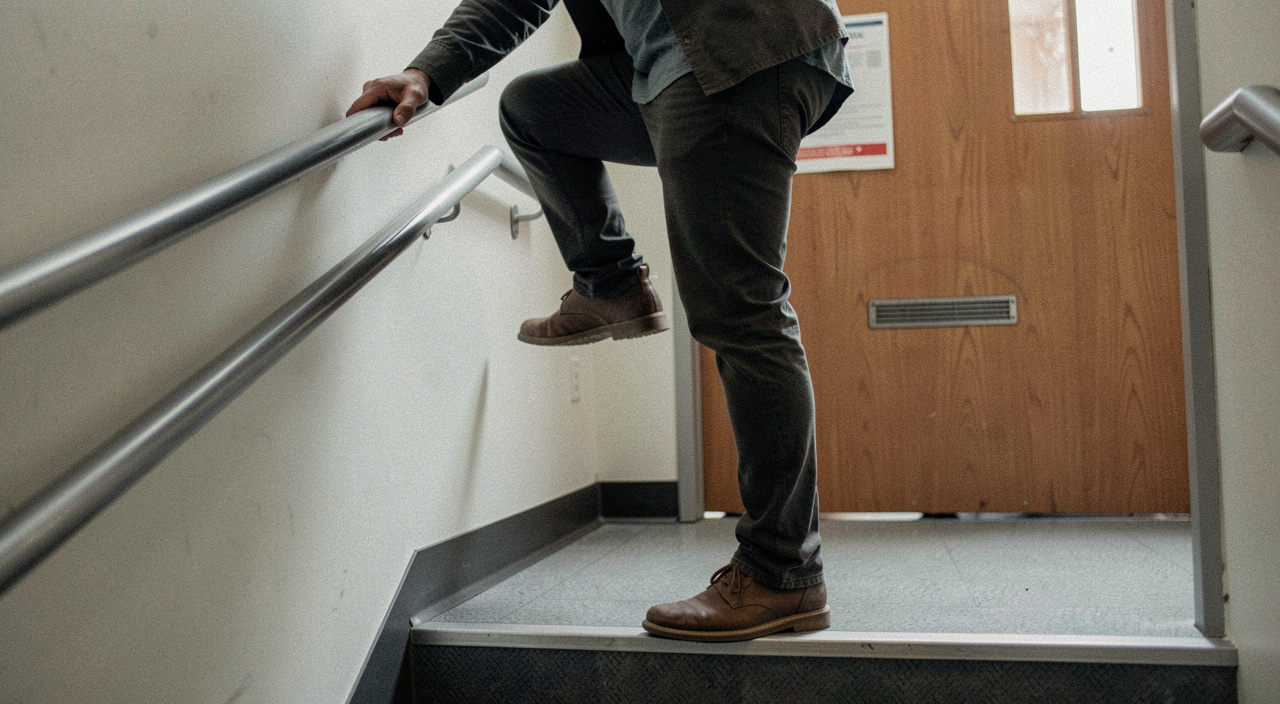
| One foot on a low step, hips eased forward | A stair, a low shelf, a chair edge | Twenty seconds each side |
That is the whole routine and it fits in the window with time to spare. There is nothing special about these four in particular. What matters is that they cover the front of the chest, the side of the neck, the shoulders and the front of the hips, which are the four places a chair quietly shortens over an afternoon.

What makes it repeat
Anything done between two meetings needs a trigger tied to the meetings themselves. The one that worked for us was leaving the room: standing up and walking to the door, whether or not there was anywhere to go. Once you are in a doorway, one of the four movements is already available.
The second thing that makes it repeat is not counting. A routine with a number attached, three sets, five repetitions, twice daily, becomes a small piece of admin and then a small failure. The version that lasted was unnumbered, and on a bad day it was one movement rather than four, which still counts.
That principle, that a habit needs a floor low enough to reach on a bad day, is the whole argument of our entry on the morning routine that survives a bad day, and it applies here more than almost anywhere else.
A routine designed for ninety seconds cannot be postponed on the grounds that there is not enough time.
The routine nobody keeps
For completeness, here is the version that does not work, because it is the one most often recommended. A fifteen minute morning routine on a mat, done before work, covering the whole body. It is a better routine by every measure except the one that matters, which is whether it happens after the second week.
Ours lasted nine days, and it failed on exactly the mornings that were busiest. That is the same failure pattern we described for the written notebook in the entry on the last hour before bed, and it is worth naming as a general rule: a habit that fails on busy days is a habit built for the wrong days.
Stretching also does not substitute for movement. Ninety seconds in a doorway relieves a specific tightness. It does not do what ten minutes on a pavement does, and treating the two as interchangeable is a mistake we made for the first few days. The distinction is set out in the piece on slow walks and brisk ones.
What we noticed
Over a fortnight, the doorway movement was the one that happened most, mainly because the trigger, standing in a doorway, is impossible to forget once it has been noticed. The neck movement happened often because it can be done seated without stopping work, which is both its advantage and its limitation.
The hip movement happened least and appeared to matter most, which is an annoying combination. The step it needs is the obstacle: on the days when the stairwell was on the way to something, it happened, and on the days when it was not, it did not.
Finally, and predictably by now, the routine did more on days when the desk itself was set up sensibly. Stretching a shoulder every ninety minutes to compensate for a screen that is ten centimetres too low is work that need not be done at all, and the fix takes ninety seconds and two books, as described in our entry on setting up a workstation.
Read next
Fixing the cause is cheaper than repeating the remedy, which is what the entry on what a desk feels like at three in the afternoon is for.
Stretching between meetings works better inside a day that already alternates posture, described in the standing and sitting entry.
A stretch is also a moment of noticing, and the habit of catching tension early is set out in the entry on where stress sits in the body.
The reason this routine is unnumbered is explained in the entry on why a streak ends the thing it counts.